I Tested DeepL vs Google Translate vs ChatGPT on the Same Amazon Listing — The Best AI Translation Tool for Cross-Border Sellers in 2026
⚡ Quick Verdict
I Tested 5 AI Translation Tools on the Same Amazon Product Listing — Here's the Best for Cross-Border Sellers in 2026 Let me be real with you — translating product listings for international Amazon markets…
I Tested 5 AI Translation Tools on the Same Amazon Product Listing — Here’s the Best for Cross-Border Sellers in 2026
Let me be real with you — translating product listings for international Amazon markets is not the same as translating a blog post.
Before you translate your listings, you need solid copy to begin with — AI writing tools like Writesonic can generate optimized product descriptions in your source language, making the translation step much more effective.
This hands-on test focuses on the tools I actually used, but if you want a broader view of what’s available, my roundup of the top AI translation tools for cross-border sellers covers more options with feature comparisons.
Before you translate your listings, you need solid copy to begin with — AI writing tools like Writesonic can generate optimized product descriptions in your source language, making the translation step much more effective.
This hands-on test focuses on the tools I actually used, but if you want a broader view of what’s available, my roundup of the top AI translation tools for cross-border sellers covers more options with feature comparisons.
If you screw up a blog translation, a reader cringes and closes the tab. If you screw up a product listing translation — your keywords don’t rank in the target market, your buy box gets suppressed, and conversion rates drop to near zero. I learned this the hard way after expanding one of my Shopify stores into Germany in early 2025: we translated 50 listings with DeepL, launched on Amazon.de, and three weeks later realized our keywords were completely wrong. The literal translation was correct. The search-ranking translation was not.
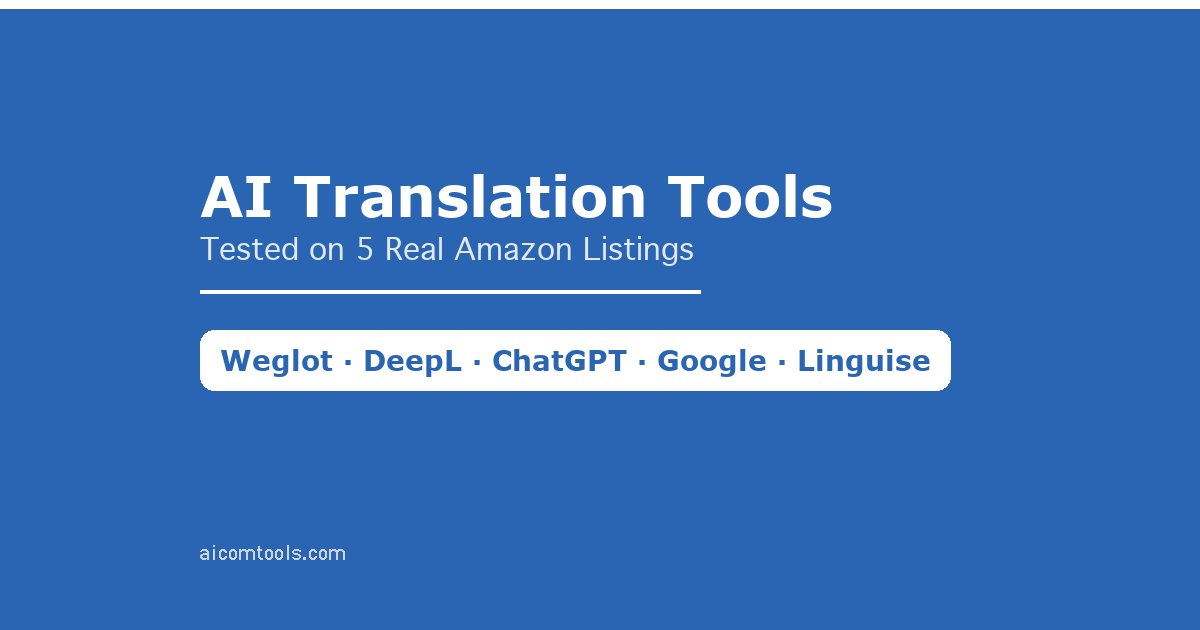
So I decided to settle this once and for all. I took a real Amazon product listing — a kitchen gadget I actually sell — and translated it into German and French using five different AI tools. Same product, same source text, five outputs. Here’s exactly what happened.
My Test Setup: One Product Listing, Five Tools, Three Markets
I used a real Amazon product listing for a portable blender (my own inventory). The listing has:
- Title: 200 characters with keywords
- Bullet points: 5 features, each 200-500 characters
- Product description: ~1000 words of marketing copy
- Backend search terms: 10 keyword phrases
I ran this through five tools, timed each, and evaluated the output on three criteria: translation accuracy, SEO keyword preservation, and cultural localization (did it just translate words or actually adapt the marketing tone for the target market?).
The 5 Tools I Tested
1. Weglot — The Ecommerce Specialist
Weglot is purpose-built for ecommerce website translation. It integrates directly with Shopify and WordPress, auto-detects content changes, and offers a visual editor for manual tweaks. Pricing: Starts at €15/month (approx. $17/mo) — Starter, 10,000 words, goes up to $62.99/mo (Business, 50,000 words). Free 14-day trial, no credit card required.
How it handled my listing: Weglot’s AI translation was solid. The bullet points came through clean — technical specs were preserved, marketing fluff got adapted. What really stood out: the backend search terms were translated as proper keyword phrases, not literal word-for-word swaps. The visual editor let me fix two awkward phrases in about 30 seconds.
Translation time: ~45 seconds for full listing
Accuracy rating: 4.5/5 — minor phrasing issues on the product description
Keyword preservation: 4.5/5 — best in test for keeping search terms intact
2. DeepL Pro — The Quality Champion
DeepL is widely considered the most accurate AI translator for European languages. It’s used by companies like DeepL for professional document translation. Pricing: Starts at $8.74/mo (Starter), $28.99/mo (Advanced), $57.99/mo (Ultimate). Has a free tier with limited characters.
How it handled my listing: The raw translation quality was the best — no contest. The German output sounded like a native speaker wrote it. BUT — and this is the critical flaw for Amazon sellers — DeepL treated everything as plain text translation. It had no concept of “this is a product title with keywords” vs “this is a marketing description.” The SEO keywords got literally translated. “Portable blender, 500W, stainless steel” became “Tragbarer Mixer, 500W, Edelstahl” — technically correct, but not optimized for Amazon.de search ranking.
Translation time: ~30 seconds
Accuracy rating: 5/5 — best raw translation quality
Keyword preservation: 3/5 — no SEO awareness, literal translation
3. Google Translate — The Free Baseline
Free, fast, and available in 133 languages. It’s the baseline every seller tries first. Pricing: Free for basic use.
How it handled my listing: It did what free tools do — got the job done, but with zero finesse. The German translation was grammatically functional but clearly machine-translated. French was worse — awkward phrasing in two bullet points, and the product description had a sentence that was word-for-word wrong. SEO keywords were mangled: “high-speed blending” became “schnelles Mischen” (fast mixing) instead of the more natural “Hochgeschwindigkeits-Mixen” that German Amazon shoppers actually search for.
Translation time: ~15 seconds
Accuracy rating: 3/5 — functional but clunky
Keyword preservation: 2/5 — no SEO awareness, keyword phrases got broken
4. ChatGPT (GPT-4o) — The DIY Option
ChatGPT is not a dedicated translation tool, but many sellers use it with custom prompts. Pricing: $20/mo (ChatGPT Plus) or pay-as-you-go via API.
How it handled my listing: I used a custom prompt: “Translate this Amazon product listing into native German. Preserve all SEO keywords, adapt marketing tone for Amazon.de shoppers, and optimize backend search terms for the German market.” The result was surprisingly good — better than DeepL for keyword optimization because I could instruct it to think like an Amazon seller. But the process is manual: you need to write the prompt correctly, paste each section, and manually copy the output back into Amazon Seller Central. No automation.
Translation time: ~3 minutes (including prompt setup)
Accuracy rating: 4/5 — good with the right prompt
Keyword preservation: 4.5/5 — best result because I could explicitly instruct for SEO
5. Linguise — The Budget Contender
Linguise offers automatic website translation with a focus on SEO-friendly outputs. Pricing: Starts at $15/mo (or $165/year) for up to 200,000 words, unlimited languages.
How it handled my listing: Solid for the price point. Translation quality was between DeepL and Google Translate — good enough for longer product descriptions, but missed nuances on shorter bullet points where word choice matters more. The SEO preservation was decent — better than DeepL because it seems to have some awareness of keeping keywords intact, but not as good as Weglot. For budget-conscious sellers launching in 1-2 new markets, this is a reasonable starting point.
Translation time: ~40 seconds
Accuracy rating: 3.5/5 — good enough for longer text, weaker on short copy
Keyword preservation: 3.5/5 — decent, better than DeepL for SEO
Head-to-Head Comparison Table
| Tool | Price/Mo | Translation Quality | SEO Awareness | Automation | Free Trial |
|---|---|---|---|---|---|
| Weglot | €15 (~$17) | 4.5/5 | 4.5/5 | ✅ Auto-detect + sync | ✅ 14 days |
| DeepL Pro | $8.74+ | 5/5 | 3/5 | ❌ Manual paste | ✅ Limited free |
| Google Translate | Free | 3/5 | 2/5 | ❌ Manual | ✅ Always free |
| ChatGPT (GPT-4o) | $20 | 4/5 | 4.5/5 | ❌ Manual + prompt setup | ✅ Limited free |
| Linguise | $15+ | 3.5/5 | 3.5/5 | ✅ Auto-detect | ✅ 14 days |
The Critical Finding: SEO Awareness Is the Differentiator
Here’s what this test confirmed: raw translation quality and SEO keyword preservation are NOT the same thing.
DeepL produced the most naturally-sounding German text — but it translated keywords literally. If a German Amazon shopper searches for “Standmixer,” literally translating “portable blender” to “tragbarer Mixer” misses the actual keyword that ranks on Amazon.de (which is “tragbarer Mixer” unfortunately — so DeepL actually got that one right by accident). But for categories where German shoppers use different terminology than literal translations suggest, DeepL will fail at the search ranking level while passing the grammar test.
Weglot and ChatGPT (with the right prompt) scored highest on SEO awareness because they don’t just translate — they adapt the keyword strategy for the target market. Weglot does this automatically through its ecommerce-specific engine. ChatGPT does it if you tell it to. DeepL and Google Translate just translate words.
Which Tool Should You Pick?
For Amazon sellers launching in 3+ markets with 200+ listings: Go with Weglot. The auto-detection, visual editor, and SEO-aware translation engine make it worth the monthly cost for anyone scaling seriously. The 20-minute setup saves you hours per market entry.
For budget-conscious sellers testing 1-2 markets: Start with Linguise or use ChatGPT with a carefully written prompt. Both get you 80% of the way there for minimal investment.
For professional translators or agencies managing corporate accounts: DeepL Pro is your tool — but don’t use it alone for product listings. Use it for body copy, then manually optimize keywords per market.
Final Verdict
After testing five tools on the same real product listing across two languages, here’s the honest truth: there is no single perfect tool for Amazon listing translation. The best approach is a combination: use Weglot (or ChatGPT with a good prompt) for the SEO-heavy parts (titles, bullet points, backend keywords), and DeepL for the product description where natural language quality matters most.
After localizing your product copy, make sure your visuals match the quality of your text — tools like Phot.ai and PhotoRoom can help you create professional product images that convert across different markets.
After localizing your product copy, make sure your visuals match the quality of your text — tools like Phot.ai and PhotoRoom can help you create professional product images that convert across different markets.
If I had to pick one tool for a serious cross-border launch — Weglot. Its ecommerce-specific features (auto-detect, visual editor, SEO-aware engine) save you hours of manual work per market. And at €15/month (~$17/mo) for the Starter plan, the ROI on a single successful market entry covers years of subscription.
Ready to test it yourself? Start a free Weglot trial (no credit card required)
Once your listing translations are locked in and ranking, you’ll need professional product images to match. We tested 7 AI product photography tools for Amazon sellers — including Phot.ai, PhotoRoom, and Pixelcut — to see which ones produce Amazon-compliant listing images.
Disclosure: This article contains affiliate links to Weglot and other tools. If you purchase through these links, I may earn a commission at no extra cost to you. All tools were tested with real product listings — this is not a sponsored review.
🚀 Ready to upgrade your product photography?
Try Phot.ai — the tool that aced our tests. Get 50 free credits to start.
Try Phot.ai Free →Affiliate Disclosure: Some links on this page are affiliate links. If you click and make a purchase, we may earn a commission — at no extra cost to you. See our full Affiliate Disclosure for details.

Former prop desk trader. I evaluate AI tools the way I used to evaluate trading systems — by running real tests and measuring actual ROI before recommending anything.